How Much Design Is Too Much?
Why every space does not need to be optimised, curated, or made legible

I attended a lecture recently that can be deemed to be impressive, by most professional standards.
The projects were refined, technically sophisticated, and aligned with a dominant trajectory in contemporary urban design: waterfront developments, riverfront revitalisations, and tourism-oriented infrastructure. These are the kinds of projects that are celebrated, circulated widely, awarded frequently, and held up as markers of urban progress.
But beneath this polished surface lies a more uncomfortable question: Why has urban design become so invested in producing spaces for consumption?
Waterfronts, in particular, have become predictable sites of intervention. These are systematically reworked across cities, into curated, legible, and marketable environments. Public space, in this process, is not just designed; it is staged.
The underlying assumption seems to be that viability, footfall, and economic return are inherently desirable outcomes. That attracting outsiders - tourists, investors, new users - is a sufficient justification for transformation.
But this raises a more critical concern: Who is this transformation actually for?
The benefits of such projects are often articulated in aggregate terms - economic growth, job creation, increased accessibility. Yet these metrics obscure as much as they reveal. They rarely account for who is displaced, whose practices are erased, or whose relationship to the space is fundamentally altered.
In many cases, what is framed as “activation” can function as a form of spatial exclusion. Spaces that were once informal, adaptive, and locally embedded are restructured to meet external expectations; that of order, aesthetics, and profitability. In the process, existing users are not always removed outright, but they are often made incompatible with the new spatial logic.
This is not incidental. It is produced.
And it points to a deeper issue within urban design practice: bias.
Not bias as an individual failing, but as a structural condition.
We are trained to see certain qualities as inherently valuable; qualities such as clarity over complexity, permanence over fluidity, formalisation over informality. We are taught to resolve, organise, and optimise. But these instincts are not neutral. They reflect a particular worldview which aligns closely with capital, governance, and visual order. As a result, urban design often does not simply respond to space, it disciplines it. It prioritises certain users while marginalising others. It legitimises some forms of occupation while rendering others illegible or undesirable.
This tendency becomes expecially visible in landscapes that already possess a strong spatial character, such as waterfronts. I was reminded of this in the lecture when some of these waterfront projects were presented as highlights. The intervention followed a familiar logic: a continuous promenade, fixed seating, lighting, kiosks, amphitheatres, clearly defined zones of movement and pause. It was active, accessible, and by most measures, successful.
And yet, something about the space felt diminished.
The beach, which once allowed for a range of informal and unstructured uses, now felt more controlled. The openness that defined it had been subtly reorganised into something more legible, and therefore more limited. And it made me question the premise itself: Do beaches need to be activated in this way?
Or more importantly, to what extent should they be activated?
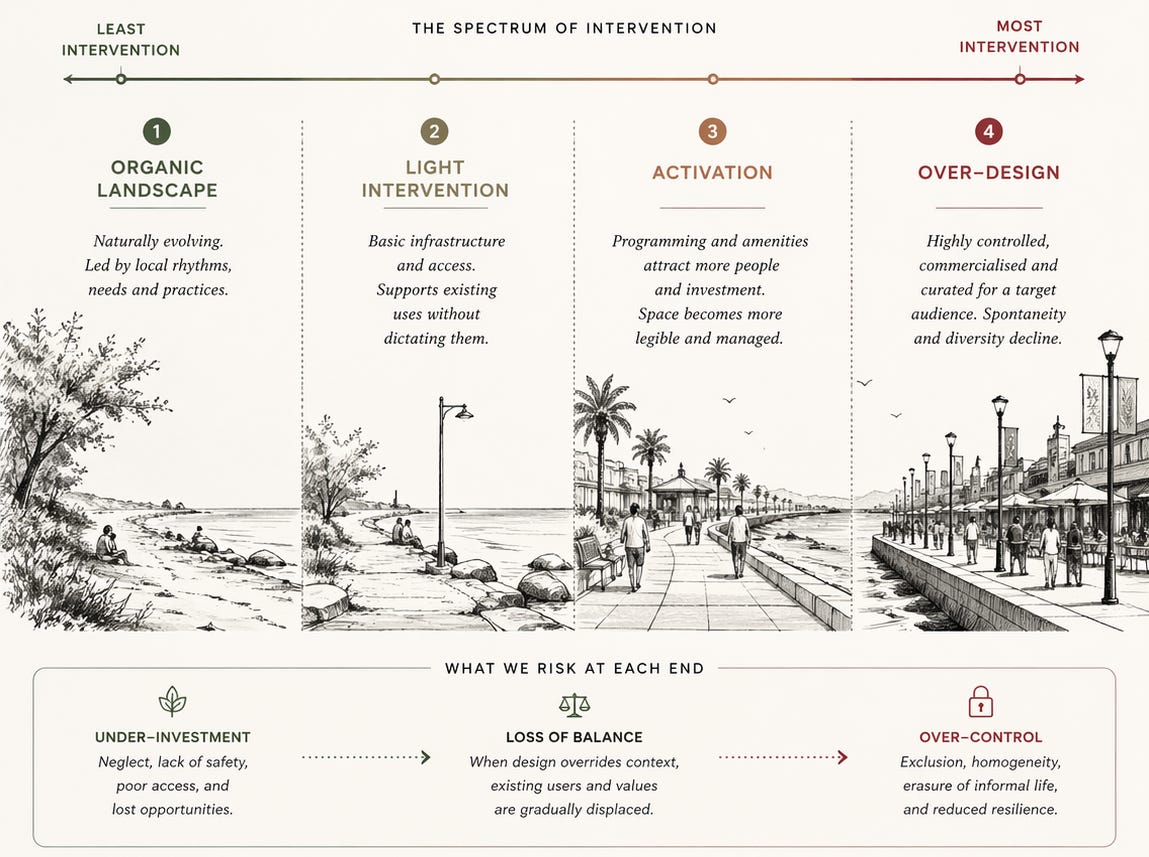
Because activation in itself is not the problem. Improving access, safety, and basic infrastructure can make spaces more inclusive and usable. But at what point does intervention begin to override the very qualities that made a place meaningful? How much of its organic, unstructured nature can, and should, be retained?
Faced with open, ambiguous landscapes, the instinct is often to organise, formalise, and enhance usability. But in doing so, we may be imposing a particular idea of what constitutes “use”; one that prioritises visibility, movement, and economic activity over quieter, less measurable forms of occupation. In this sense, design does not simply add to a place. It redefines it. And not always in ways that are inclusive.
What appears as improvement can also function as a form of filtering: privileging certain users, behaviours, and rhythms, while making others less viable. The space becomes easier to navigate, but narrower in how it can be inhabited.
This raises an uncomfortable but necessary question about the role of the urban designer: Are we shaping cities in response to lived realities, or are we reshaping them to fit pre-determined ideals? And further, who gives us the authority to decide?

The answer is not to reject intervention altogether. But it does require a more critical awareness of how and why we intervene, and when to stop. If bias is embedded in our training, then unlearning cannot be superficial. It demands more than community consultations or participatory checklists. It requires a re-evaluation of what we consider expertise, whose knowledge we privilege, and what outcomes we define as successful.
It may also require a willingness to accept limits.
To recognise that not all spaces need to be optimised.
That not all value can be measured through economic return.
And that not all forms of informality are problems to be solved.
In this sense, restraint is not a lack of ambition - it is a design decision.
Because the question is no longer what should we design?
But whether we should design at all, and for whom?
Until that question is taken seriously, urban design risks continuing to produce spaces that are highly functional, highly visible, and yet fundamentally disconnected from the people they claim to serve.